- (727) 591-5300
- support@nearnetlocal.com
- 7904 Willow Brook CT, Hudson FL 34667
At 2:30 AM on a Tuesday, Sarah’s HVAC company received a scathing one-star review from an angry customer whose air conditioner failed during a heatwave. By the time Sarah discovered it the next afternoon, the review had been seen by dozens of potential customers, and three scheduled consultations had mysteriously cancelled. This scenario plays out thousands of times daily across local service businesses—manual review management isn’t just inefficient, it’s bleeding revenue.
The hard truth: In today’s hyper-connected marketplace, your reputation moves at internet speed, but most local service businesses are managing it at human speed. While you’re sleeping, eating dinner, or focused on actual service delivery, your online reputation is either building your business or quietly destroying it. The gap between when reviews appear and when you respond isn’t just a customer service issue—it’s a revenue leak that compounds daily.
But here’s what separating the winning local service businesses from the struggling ones: They’ve stopped treating review management as a reactive chore and started leveraging it as an automated revenue generation system. They’re not just collecting reviews—they’re systematically converting reputation into recurring revenue through intelligent automation that works 24/7, nurtures customer relationships, and turns every review into business intelligence that drives growth.
This isn’t about buying another software tool or hiring a virtual assistant to monitor your profiles. This is about building a reputation automation system that generates reviews at optimal moments, responds intelligently to feedback, extracts actionable business insights from customer sentiment, and proves its ROI through measurable revenue impact. For serious local service businesses ready to scale beyond the limitations of manual reputation management, automation isn’t just helpful—it’s essential for sustainable competitive advantage.
The biggest mistake local service businesses make with review generation is treating it like a one-size-fits-all marketing campaign. Successful review automation starts with understanding that different customers require different approaches at different
moments in their journey. A plumbing emergency customer who just had their basement flooding stopped isn’t in the same headspace as a homeowner who completed a planned bathroom renovation—yet most businesses send identical review requests to both.
Effective automated review request workflows begin with customer journey mapping that identifies optimal emotional and logistical moments for review solicitation. For emergency services, this typically occurs 24-48 hours after problem resolution when relief has set in but the experience remains fresh. For planned services like landscaping or home improvement, the optimal window often extends 3-7 days post-completion, allowing customers to enjoy results while details remain memorable.
Multi-platform review solicitation requires strategic platform prioritization based on your customer demographics and business model. Google Business Profile dominates local search visibility, making it the primary focus for most service businesses. However, industry-specific platforms often carry more weight for particular services— Angie’s List for home services, Yelp for restaurants and personal services, Facebook for community-oriented businesses, and specialized platforms like HomeAdvisor or Thumbtack for contractor services.
The key to personalized review requests that feel human rather than robotic lies in dynamic content insertion and contextual messaging. Instead of generic “Please review us” templates, sophisticated automation systems pull specific service details, technician names, and project outcomes into personalized messages. A successful automated request might read: “Hi John, we hope you’re enjoying your new granite countertops!
Mike mentioned you were thrilled with how the seams turned out. Would you mind sharing your experience to help other homeowners planning similar projects?”
Compliance-safe automation requires understanding platform-specific policies around review solicitation. Google prohibits incentivizing reviews, requiring careful message crafting that requests feedback without offering rewards. Yelp explicitly discourages any form of review solicitation, making organic generation through exceptional service the only safe approach. Facebook allows review requests but prohibits fake reviews or manipulation attempts. Successful automation systems include compliance checks and platform-appropriate messaging variations.
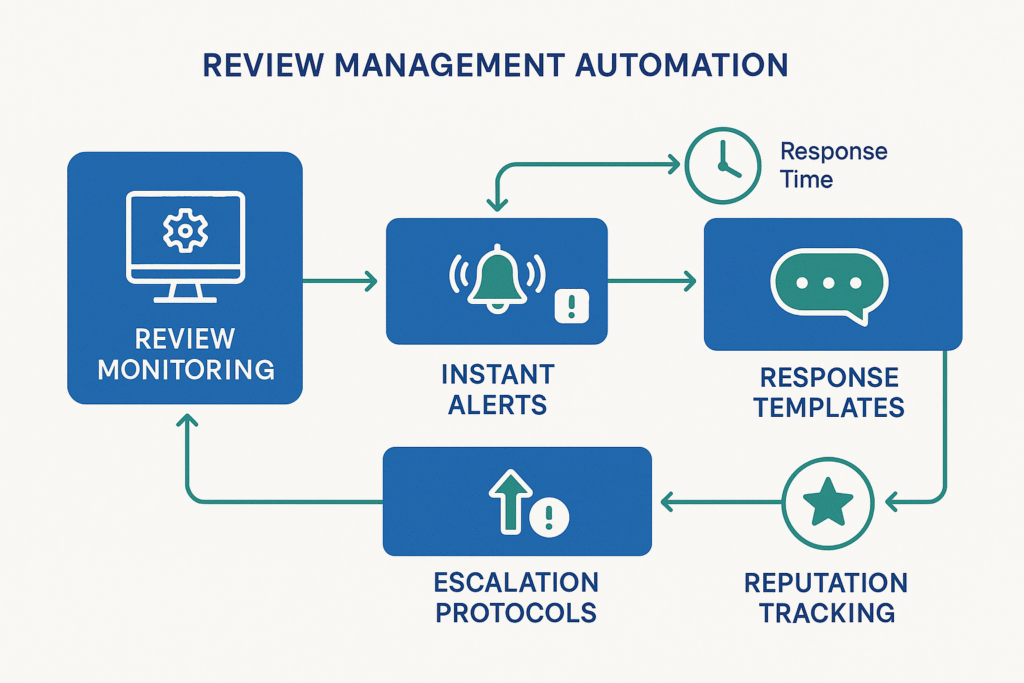
Response speed in review management isn’t just about customer service—it’s about search engine algorithms and potential customer perception. Google’s local search algorithm considers response frequency and speed as ranking factors, while potential customers view quick responses as indicators of business professionalism and customer care. Manual response management means inevitable delays, inconsistent messaging, and missed opportunities to turn public feedback into marketing assets.
Effective response template systems require sophisticated categorization that goes beyond simple positive/negative classifications. Successful automation distinguishes between effusive praise (requiring gratitude and specific acknowledgment), constructive feedback (needing acknowledgment and improvement commitment), factual complaints (demanding detailed response and resolution explanation), and
unfair attacks (requiring professional defense without escalation). Each category
triggers appropriate template variations that maintain brand voice while addressing specific review content.
Alert and notification automation ensures immediate response capability without requiring constant platform monitoring. Advanced systems use sentiment analysis algorithms to prioritize urgent responses—a mention of “health hazard” or “safety concern” triggers immediate executive alerts, while routine praise generates standard appreciation responses within designated timeframes. Geographic notification routing ensures multi-location businesses direct responses through appropriate local management channels.
Sentiment analysis integration enables sophisticated response prioritization that considers context beyond star ratings. A three-star review mentioning “excellent technician but expensive pricing” requires different handling than a three-star review citing “delayed service and poor communication.” Advanced systems analyze keyword sentiment, emotional language, and specific complaint categories to route responses appropriately and generate relevant template variations.
Multi-location review management scaling requires centralized oversight with local customization capabilities. Corporate brands need consistent messaging standards while allowing local managers to address location-specific issues and maintain community connections. Automated systems can enforce brand guidelines while enabling local customization through approved template variations and regional response routing.
Crisis management automation becomes crucial when negative reviews cluster around specific incidents or time periods. Automated monitoring systems detect unusual negative review patterns and trigger escalation protocols before reputation damage compounds. This includes executive notification sequences, legal consultation triggers for serious allegations, and coordinated response strategies that prevent negative review avalanches from destroying months of reputation building.
The most successful local service businesses treat reviews as a continuous stream of market research rather than simple reputation indicators. Every review contains customer behavior insights, service delivery feedback, competitive intelligence, and operational improvement opportunities. Manual analysis means most of this intelligence gets ignored, but sophisticated automation systems extract actionable business insights that drive strategic decisions and operational improvements.
Automated sentiment tracking goes far beyond simple positive/negative classifications to identify specific performance trends and customer satisfaction patterns. Advanced systems analyze keyword frequency, emotional language evolution, and service-specific feedback to identify improvement opportunities before they become widespread complaints. A landscaping company might discover that spring cleanup reviews consistently mention “thorough but slow” while summer maintenance reviews praise “efficient and reliable”—intelligence that guides seasonal staffing and service delivery adjustments.
Competitive review monitoring provides automated market intelligence that reveals competitor strengths, weaknesses, and customer switching motivations. Systematic analysis of competitor reviews identifies market gaps, pricing sensitivity patterns, service differentiation opportunities, and customer frustration points that create business development targets. This intelligence guides service expansion decisions, pricing strategies, and competitive positioning without expensive market research investments.
Customer feedback categorization automation enables systematic operational improvements by identifying specific improvement areas and tracking progress over time. Instead of treating each review as an isolated incident, sophisticated systems aggregate feedback patterns to identify systematic issues requiring operational changes. If multiple reviews mention “difficult to schedule appointments,” this triggers examination of booking processes and staff training rather than individual response management.
Performance reporting automation provides executive-level insights that connect review management to business outcomes. Automated dashboards track review generation rates, response times, sentiment trends, and conversion correlations to demonstrate reputation management ROI. These systems identify which review generation strategies produce highest-quality feedback, which response approaches generate follow-up business, and which operational changes result in measurable satisfaction improvements.
Integration with business improvement processes ensures review insights drive actual operational changes rather than remaining as interesting data points. Automated systems can trigger training protocols when specific complaint patterns emerge, adjust service delivery procedures based on feedback trends, and modify marketing messaging to address recurring customer concerns. This closes the loop between customer feedback and business improvement in ways that manual analysis rarely achieves.
The ultimate measure of review automation success isn’t the number of reviews generated or response time improvements—it’s measurable impact on revenue generation and business growth. Sophisticated local service businesses implement tracking systems that connect review management activities directly to customer
acquisition, retention, and lifetime value improvements. This requires attribution modeling that traces the customer journey from review visibility through service booking and long-term relationship development.
Conversion tracking methodologies for review-driven traffic require integration between review platforms, website analytics, and customer relationship management systems. Advanced tracking uses UTM parameters, phone number tracking, and conversion pixels to attribute service bookings to specific review visibility events. A roofing company might discover that customers who read reviews before calling have 40% higher project values and 60% better payment reliability than referral customers— intelligence that justifies significant review automation investment.
Customer lifetime value impact measurement reveals the long-term revenue effects of review automation beyond initial service bookings. Customers acquired through review-driven research often demonstrate higher satisfaction rates, increased referral generation, and improved retention for recurring services. Automated tracking systems measure these extended value impacts to calculate true ROI of review management investments, often revealing returns significantly higher than immediate conversion tracking suggests.
Cost-benefit analysis frameworks for automation tools require comprehensive evaluation beyond monthly software fees. Successful analysis includes time savings quantification, response quality improvements, missed opportunity prevention, and competitive advantage value. A $500 monthly automation investment that prevents one negative review crisis or generates two additional high-value customers typically
provides significant positive ROI, but these benefits require systematic measurement to demonstrate value.
Scaling strategies across service areas and teams require automation systems that maintain quality while increasing volume capabilities. Multi-location businesses need centralized analytics with local customization, while growing teams require training integration and performance standardization. Successful scaling maintains personalization quality while reducing per-review management costs through systematic efficiency improvements.
Revenue attribution models prove automation ROI through sophisticated customer journey analysis that connects review management activities to business outcomes. Advanced models track customer behavior from initial review exposure through service completion and long-term relationship development, providing comprehensive ROI calculations that justify automation investments and guide optimization strategies.
© 2025 Nearnet Digital Solutions LLC All Rights Reserved.
Terms of Service | Privacy Policy | Trusted Partners